Pregnancy in Korea: A Complete Guide for Foreigners in Daegu
Insurance, vouchers, prenatal care and choosing where to deliver in Daegu
Medically reviewed by Dr. Yeo Jun-young, MD, PhD, board-certified OB-GYN · Last updated September 2026
Think you might be pregnant in Korea? This guide explains pregnancy in Korea for foreigners, step by step, with a Daegu focus. You'll learn how to confirm a pregnancy, how National Health Insurance helps, and how to choose where to give birth.
Quick answerPregnancy in Korea for foreigners usually starts with a pregnancy test and ultrasound at an OB-GYN clinic. If you have National Health Insurance (NHIS), you can apply for the National Happiness Card voucher (KRW 1,000,000 per single pregnancy) and pay a reduced 10% outpatient copay at clinics. Because clinics like ours do not deliver babies, you'll choose a hospital with a delivery unit for the rest of your care.
How do I confirm a pregnancy in Daegu?
You can confirm a pregnancy at any OB-GYN clinic in Daegu with a urine or blood test and, when it's early enough to see, a pelvic ultrasound. In Korea, pregnancy is usually confirmed by ultrasound at an OB-GYN, and that visit is the starting point for everything else.
A pharmacy (약국) home test is a fine first step. A clinic visit adds a doctor's exam, an ultrasound, and the paperwork for insurance benefits.
At Y Lady Women's Clinic, a pregnancy test is same-day and takes about 20 minutes. Our three female, board-certified OB-GYNs can check early pregnancy, and our team answers English messages on WhatsApp so you can ask questions before and after your visit.
What should I bring to my first visit?
Bring your ID and the date your last period started. That date is the first thing any gynecologist in Daegu will ask for.
- Alien Registration Card (ARC) or passport
- NHIS card or number, if you're enrolled
- Date of your last menstrual period
- A list of medicines or supplements you take
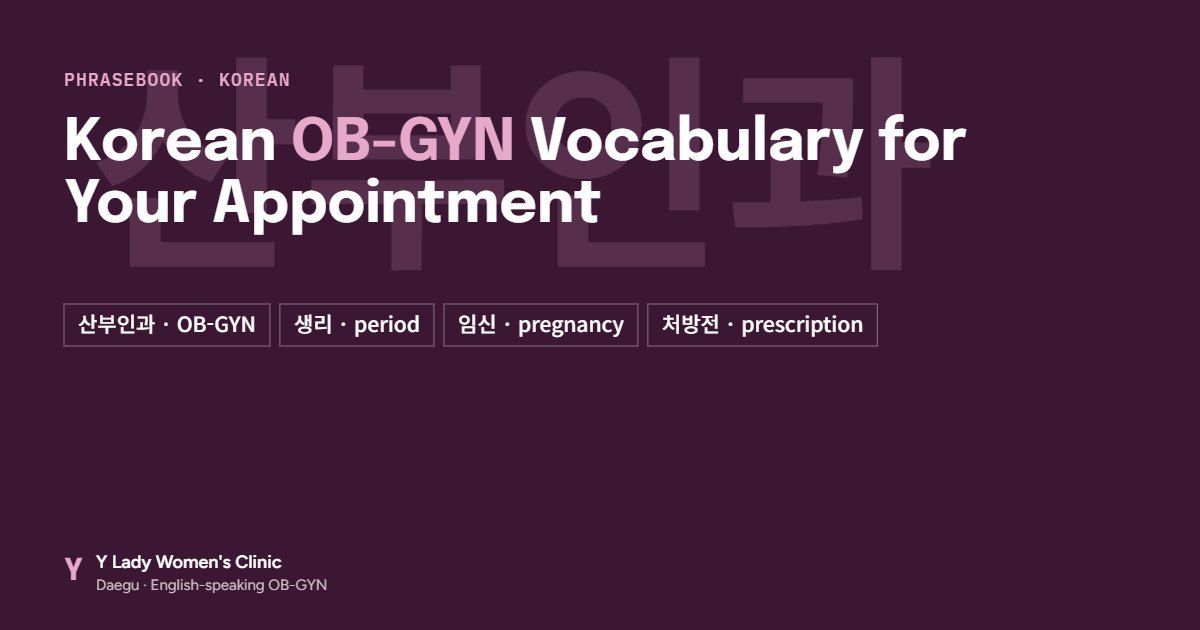
Korean words to show the front desk
Show these words at clinics without English support:
- Pregnancy — Korean: 임신; Say it: im-shin
- Pregnancy test — Korean: 임신 검사; Say it: im-shin geom-sa
- Maternal handbook — Korean: 산모수첩; Say it: san-mo su-cheop
- Delivery (childbirth) — Korean: 분만; Say it: bun-man
- Emergency room — Korean: 응급실; Say it: eung-geup-shil
Can foreigners use NHIS for pregnancy care in Korea?
Yes. Foreigners enrolled in the National Health Insurance Service (NHIS) get the same pregnancy benefits as Korean subscribers, including the reduced copay and the pregnancy voucher. The key question is whether you're enrolled yet.
What is the NHIS 6-month rule?
The 6-month rule means most foreigners must live in Korea for at least 6 months before they can join NHIS as a regional (self-employed) subscriber or dependent. It has applied since April 3, 2024.
There are exceptions. Dependents on D-2, D-4-3, E-9, F-5, and F-6 visas, minors under 19, and foreign spouses of Korean citizens are exempt from the wait. If you work for a Korean employer, you're usually enrolled through your workplace from the start.
If you're not covered yet, you can still see a doctor; you'll pay the full cost, so ask for an estimate first.
How much does pregnancy care cost in Korea?
Costs depend on two things: whether a service is covered by NHIS, and what type of facility you visit. We don't list prices here because they vary by clinic, hospital, and test. Ask each facility for an estimate.
Here's how the cost structure works for NHIS members:
- Covered outpatient care at a clinic (의원), not pregnant — What you pay: 30% of covered costs; Notes: Standard NHIS copay
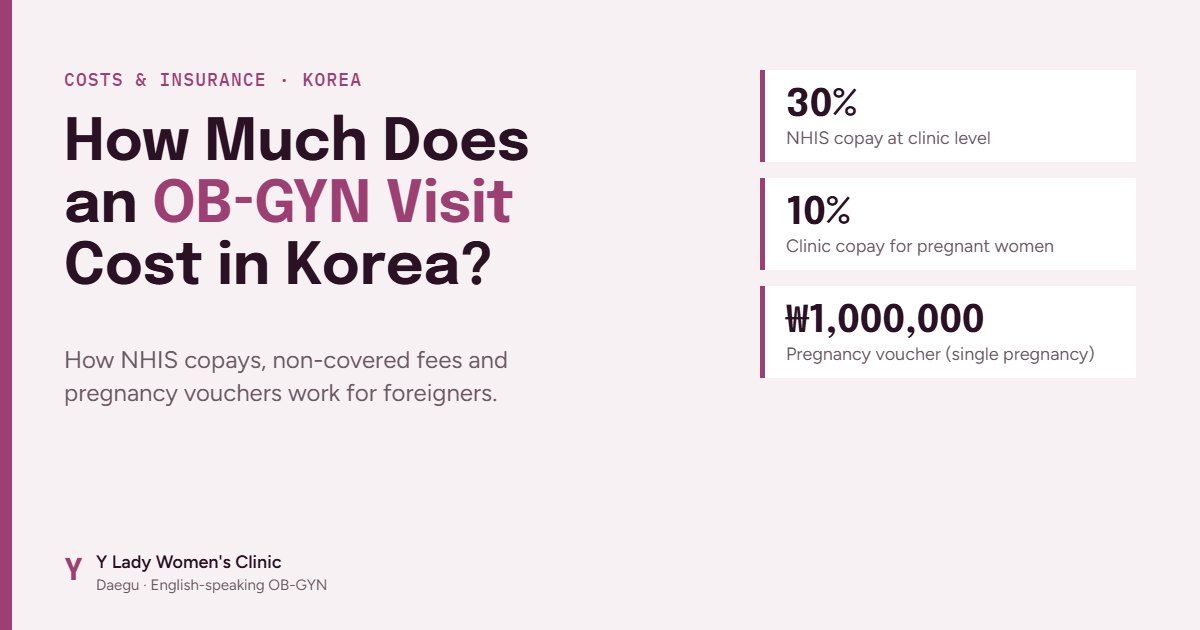
- Covered outpatient care at a clinic, pregnant — What you pay: 10% of covered costs; Notes: Bring proof of pregnancy or your maternal handbook
- Non-covered services (비급여) — What you pay: 100%; Notes: Ask for the clinic's non-covered fee list
- Covered delivery costs (vaginal or C-section) — What you pay: 0% since Jan 1, 2025; Notes: Applies to covered items only
- No NHIS enrollment — What you pay: 100%; Notes: Ask for an estimate first
What is the National Happiness Card voucher?
The National Happiness Card (국민행복카드) is a government-backed card loaded with a pregnancy and childbirth voucher. As of 2026, it provides KRW 1,000,000 per single pregnancy and KRW 1,400,000 for twins or more. Residents of medically underserved areas get an extra KRW 200,000.
It's for NHIS subscribers and dependents with a confirmed pregnancy, and it helps with pregnancy-related medical costs.
To apply:
- Confirm your pregnancy with an OB-GYN.
- Ask the clinic for the pregnancy confirmation document you'll need.
- Apply through NHIS or the voucher portal (voucher.go.kr). Ask NHIS about the current steps, because the process can change.
How does the 10% pregnancy copay work?
The 10% copay is a reduced outpatient copay for pregnant NHIS members at clinic-level (의원) facilities, in place since 2017. It applies to covered care only.
Show your pregnancy confirmation or maternal handbook at the front desk so the reduced rate is applied.
What is a maternal handbook in Korea?
A maternal handbook (산모수첩, sanmo sucheop) is a small booklet that records your pregnancy: test results, ultrasound findings, and upcoming visits. Your prenatal care provider usually gives it to you early on.
Bring it to every appointment, including emergency visits. It also works as proof of pregnancy for the reduced copay.
How often will I have prenatal visits?
Most healthy pregnancies follow a monthly rhythm that speeds up near the due date. The U.S. Office on Women's Health describes a typical schedule:
- Weeks 4–28: about once a month
- Weeks 28–36: about twice a month
- Week 36 to birth: about once a week
The World Health Organization (WHO) recommends at least eight antenatal care contacts, with the first in the first trimester (up to 12 weeks). High-risk pregnancies need more frequent visits. Your delivering hospital will set your exact schedule.
Where can I give birth in Daegu as a foreigner?
You'll give birth at a hospital or women's hospital with a labor and delivery unit. Y Lady Women's Clinic does not deliver babies and has no maternity ward. We can confirm your pregnancy and provide gynecological care, then you'll continue with a delivering hospital.
Which Daegu hospitals offer help for foreigners?
According to Daegu Metropolitan City, these hospitals offer international services or English-speaking staff. Confirm obstetric services and language support before your first visit.
- Keimyung University Dongsan Medical Center — Foreigner support listed: International Medical Center
- Yeungnam University Medical Center — Foreigner support listed: International Health Service Center
- Daegu Fatima Hospital — Foreigner support listed: International Medical Center
- Kyungpook National University Hospital — Foreigner support listed: Designated English-speaking staff
- Daegu Catholic University Medical Center — Foreigner support listed: English-speaking staff available
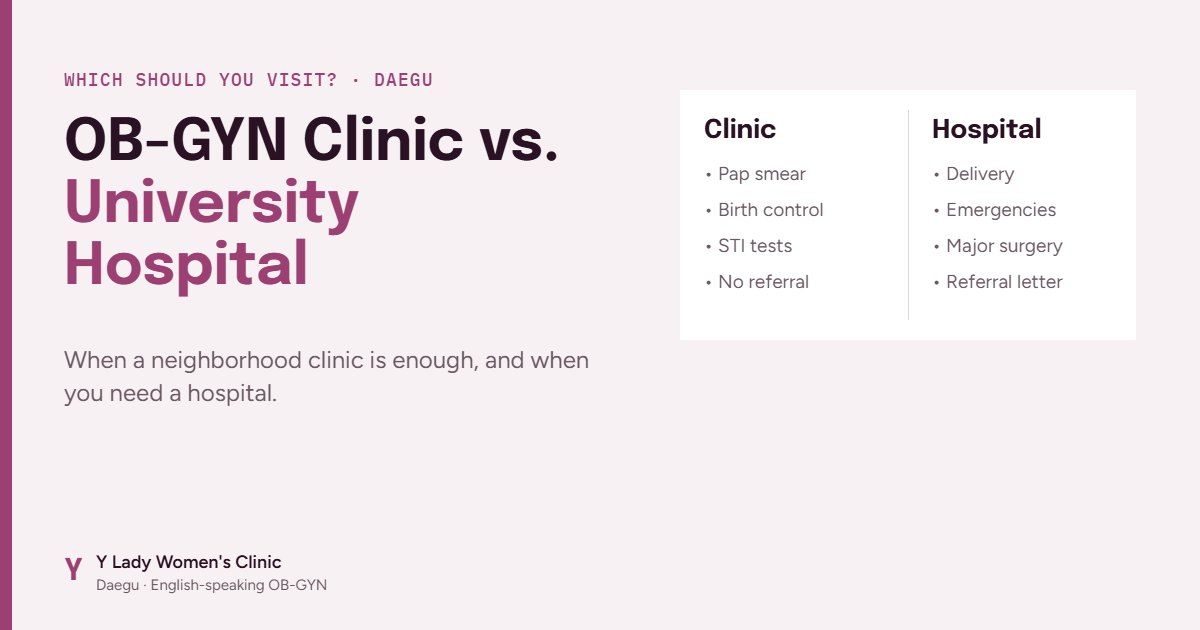
Clinic, women's hospital, or university hospital?
Each option fits a different need:
- Pregnancy test and early ultrasound — OB-GYN clinic (like Y Lady): Yes; Women's hospital: Yes; University/general hospital: Yes
- Delivers babies — OB-GYN clinic (like Y Lady): No; Women's hospital: Usually; University/general hospital: Yes (confirm)
- Referral letter usually needed — OB-GYN clinic (like Y Lady): No; Women's hospital: Usually no; University/general hospital: Often, to get NHIS rates at tertiary hospitals
- Best for — OB-GYN clinic (like Y Lady): Confirming pregnancy, gynecology; Women's hospital: Routine pregnancies; University/general hospital: Higher-risk pregnancies, complex care
At tertiary (상급종합) hospitals, you'll usually need a referral letter (진료의뢰서) from a clinic to pay NHIS rates. Without one, you may pay more. A clinic can write this for you.
What practical things should foreigners know?
Paperwork and language cause most of the stress. A few early steps help.
- Check your NHIS status now. If you're inside the 6-month wait, plan your budget accordingly.
- Keep every receipt. Ask for itemized receipts (진료비 영수증) and detailed statements for travel or private insurance claims.
- Save the address in Korean. Taxi drivers need it in Hangul.
- Book by message. Many clinics, including ours, answer in English by WhatsApp.
- Know your visa timeline. If your visa ends before your due date, ask immigration (1345) early.
Can I take maternity leave in Korea?
Yes. Under Korean labor rules, employers must give pregnant employees 90 days of maternity leave, or 120 days for twins or more. At least 45 days (60 for multiples) must come after the birth.
Pregnant employees can also ask to work two hours less per day, without a pay cut, before 12 weeks or after 36 weeks. Check the details with your employer's HR team.
When should I go to the ER instead of a clinic?
Call 119 or go to a hospital emergency room (응급실) right away for serious symptoms. Don't wait for a clinic appointment. The 119 service offers English interpretation.
The U.S. Centers for Disease Control and Prevention (CDC) lists urgent warning signs, including:
- Vaginal bleeding or leaking fluid
- Belly pain that doesn't go away
- Severe headache or vision changes
- Trouble breathing or chest pain
- A fever of 100.4°F (38°C) or higher
- Your baby moving less than usual
- Thoughts of harming yourself or your baby
Frequently asked questions
Can I get a pregnancy test at an OB-GYN in Daegu without an appointment?Walk-in policies vary by clinic, so message first to avoid a long wait. At Y Lady, a pregnancy test is same-day and takes about 20 minutes. Message us on WhatsApp to check availability.
Is there an English-speaking OB-GYN in Daegu?Yes. Y Lady Women's Clinic in Jung-gu is an English-friendly clinic with three female OB-GYNs and English support by WhatsApp. Several Daegu university hospitals also have international centers or English-speaking staff.
Does Y Lady deliver babies?No. Y Lady Women's Clinic does not deliver babies or have a maternity ward. We confirm pregnancy and provide gynecological care. For delivery, choose a hospital with a labor and delivery unit.
Can I get the pregnancy voucher without NHIS?No. The National Happiness Card voucher is for NHIS subscribers and dependents with a confirmed pregnancy. If you're still in the 6-month wait, check whether you qualify for an exception.
How much is the pregnancy voucher in Korea?As of 2026, it's KRW 1,000,000 for a single pregnancy and KRW 1,400,000 for multiples. An extra KRW 200,000 applies in medically underserved areas.
What number do I call in a pregnancy emergency in Korea?Call 119 for an ambulance. English interpretation is available. For immigration questions, call 1345.
Key takeaways
- Start with a pregnancy test and ultrasound at an OB-GYN clinic; Y Lady offers same-day tests in about 20 minutes.
- Most foreigners need 6 months of residence before NHIS enrollment, with exceptions for certain visas, minors, and spouses of Koreans.
- NHIS members get a pregnancy voucher (KRW 1,000,000 single, KRW 1,400,000 multiple) and a 10% outpatient copay at clinics.
- Y Lady does not deliver babies. Choose a Daegu hospital with a delivery unit early.
- For emergencies, call 119.
Talk to us
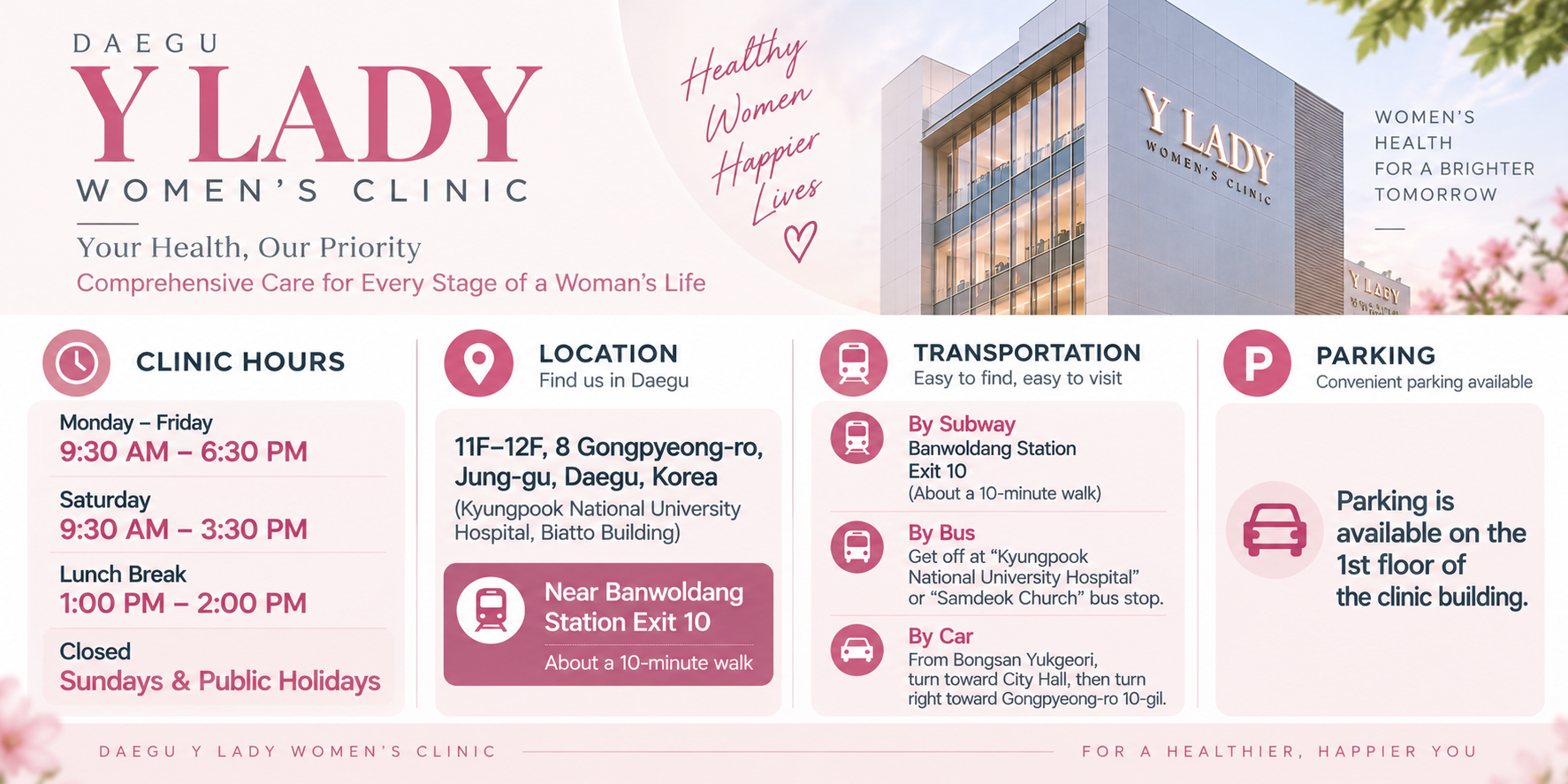
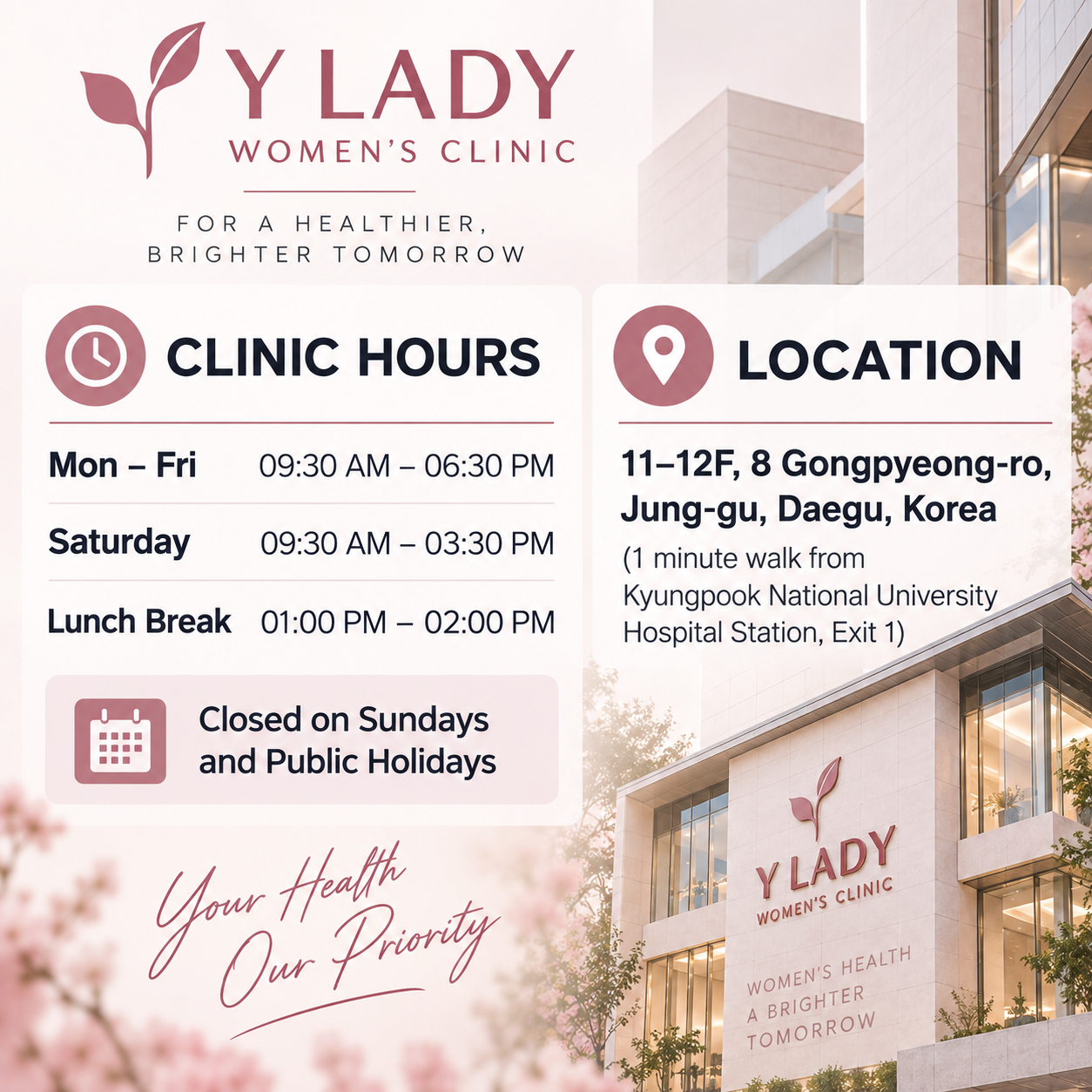
If you think you're pregnant, our English-speaking OB-GYN team in Jung-gu, Daegu, can help confirm it and explain your options. We're opposite Samdeok Fire Station, near Kyungpook Nat'l Univ. Hospital Station (Line 3) and Banwoldang Station (Lines 1 and 2). Address for taxis: 대구광역시 중구 공평로8길 11-1 2층. Message us on WhatsApp; we reply within 24 hours, except Sundays and holidays.
Sources
- National Health Insurance Service (NHIS), English site
- Korea.net, NHIS 6-month rule for foreigners
- Daegu Metropolitan City, hospitals for foreigners
- Office on Women's Health, Prenatal care and tests
- WHO Recommendations on Antenatal Care for a Positive Pregnancy Experience (2016)
- CDC, Urgent Maternal Warning Signs
- InvestKOREA, Work-family balance assistance (maternity leave)