Daegu OB-GYN vs. University Hospital: Which Should Foreigners Visit?
When a neighborhood clinic is enough, and when you need a hospital
Medically reviewed by Dr. Yeo Jun-young, MD, PhD, board-certified OB-GYN · Last updated September 2026
If you need women's health care in Daegu, you'll quickly face a choice: a local OB-GYN clinic or a big university hospital. This guide explains which one fits your situation, how referrals and copays work, and what to do in an emergency.
Quick answer For routine care, such as Pap smears, ultrasounds, contraception, STI tests, and pregnancy confirmation, a local OB-GYN clinic (의원) in Daegu is usually the right first stop. University hospitals (상급종합병원) are better for complex surgery, high-risk pregnancy, delivery, and cancer treatment. To use them at NHIS rates, you usually need a referral letter (진료의뢰서) from a clinic. Emergencies: call 119.
What is the difference between an OB-GYN clinic and a university hospital in Korea?
The main difference is the level of care. An OB-GYN clinic (의원, uiwon) is a primary care facility for outpatient visits. A tertiary general hospital (상급종합병원, sanggeup jonghap byeongwon) is a large teaching hospital designed for serious, complex, or specialized conditions.
Korea's healthcare system is organized in tiers:
- Clinic (의원): Outpatient care. Most women's clinics and 산부인과 in Daegu are at this level.
- Hospital (병원) and general hospital (종합병원): Mid-sized facilities, often with inpatient beds.
- Tertiary general hospital (상급종합병원): Major university medical centers with specialist departments, surgery, intensive care, and research.
The National Health Insurance Service (NHIS) sets lower copays at clinics to encourage patients to start there. Hospitals are meant for cases that need more.
Clinic vs. university hospital: how do they compare?
A clinic is faster and cheaper for routine needs, while a university hospital has the equipment and teams for complex cases. The table below summarizes the key differences.
- Best for — OB-GYN clinic (의원): Routine exams, screening, contraception, infections, pregnancy confirmation; University / tertiary hospital (상급종합병원): Complex surgery, high-risk pregnancy, delivery, cancer treatment
- Referral needed? — OB-GYN clinic (의원): No; University / tertiary hospital (상급종합병원): Usually yes, for NHIS rates
- NHIS outpatient copay — OB-GYN clinic (의원): 30% of covered costs; University / tertiary hospital (상급종합병원): 60% of treatment costs (per NHIS)
- Booking — OB-GYN clinic (의원): Often same-day or walk-in; University / tertiary hospital (상급종합병원): Appointments may take longer to get
- Wait on the day — OB-GYN clinic (의원): Usually shorter; University / tertiary hospital (상급종합병원): Often longer, with multiple departments
- Doctor continuity — OB-GYN clinic (의원): You typically see the same doctor; University / tertiary hospital (상급종합병원): May vary by department and schedule
- English support — OB-GYN clinic (의원): Varies by clinic; University / tertiary hospital (상급종합병원): Some have international centers
- Delivery / inpatient care — OB-GYN clinic (의원): Many clinics, including Y Lady, don't deliver babies; University / tertiary hospital (상급종합병원): Yes, with labor wards and surgical teams
- Emergencies — OB-GYN clinic (의원): Not an emergency facility; University / tertiary hospital (상급종합병원): Has an emergency room (ER)
Copay figures come from the NHIS English website. Non-covered (비급여) services are paid 100% by the patient at any level.
When should you visit a local OB-GYN clinic in Daegu?
Visit a clinic for everyday women's health needs that don't require surgery or hospital admission. For most foreigners, an OB-GYN in Daegu at clinic level is the most practical starting point.
Typical reasons to choose a clinic:
- Screening: Pap smear, colposcopy, pelvic ultrasound
- Contraception: Pills, emergency contraception, IUD insertion or removal, Implanon, injections
- Infections: Vaginal discharge, itching, suspected STIs
- Period problems: Painful, heavy, or irregular periods
- Pregnancy: Early confirmation with a pregnancy test and ultrasound
- Chronic conditions: PCOS, endometriosis, fibroids, and menopause care
- Vaccines: Gardasil 9 (HPV vaccine)
Can a clinic handle more than check-ups?
Yes. Many OB-GYN clinics offer outpatient procedures and ongoing management of conditions like fibroids or endometriosis. At Y Lady Women's Clinic, for example, services include IUDs, colposcopy, HIFU, and myomectomy. Ask any clinic directly what it can treat on site.
Is the copay really lower at a clinic?
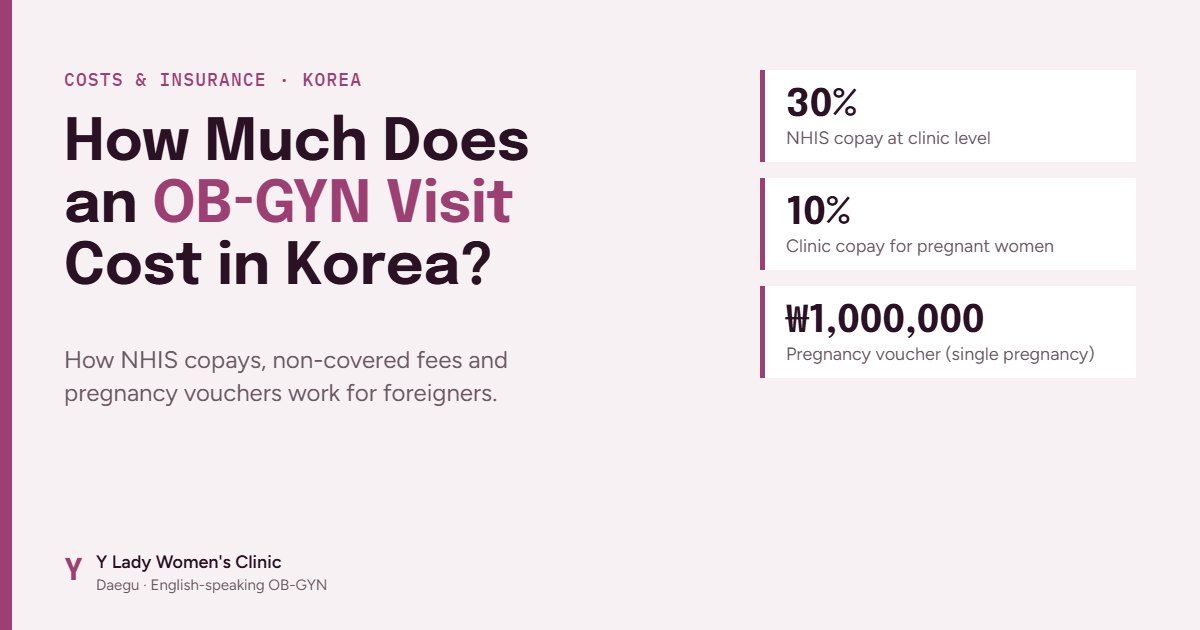
Yes. According to NHIS, patients pay 30% of covered outpatient costs at the clinic level, compared with 60% at tertiary hospitals. Pregnant women with NHIS pay a reduced 10% outpatient copay at clinic level.
When should you go to a university hospital instead?
Go to a university hospital when your condition needs specialized teams, surgery, inpatient care, or a labor ward. A clinic doctor will usually tell you when this is the case.
Situations that often call for a tertiary hospital:
- Delivery: Giving birth requires a hospital or women's hospital with a delivery unit.
- High-risk pregnancy: For example, complications that need specialist monitoring.
- Gynecologic cancer: Diagnosis confirmation, surgery, chemotherapy, or radiation.
- Complex surgery: Cases requiring advanced surgical teams or intensive care backup.
- Multiple medical conditions: When several specialists need to work together.
Do you need a university hospital for pregnancy care?
Not always. Many women in Korea have pregnancy confirmed at a local OB-GYN, receive a maternal handbook (산모수첩), and then continue prenatal visits wherever they plan to deliver. If your pregnancy is high risk, your doctor may recommend hospital-based care from early on.
Do you need a referral letter to see a university hospital doctor?
Usually, yes. At tertiary hospitals, patients generally need a referral letter (진료의뢰서, jillyo uiroeseo) from a clinic to be charged at NHIS rates. Without one, you may pay considerably more.
How do you get a referral letter in Daegu?
Getting a referral is a simple process at most clinics:
- Visit a clinic first. See a gynecologist in Daegu about your symptoms or test results.
- Get an assessment. The doctor examines you and reviews any results.
- Receive the 진료의뢰서. If hospital care is needed, the clinic writes the letter.
- Collect copies of records. Ask for test results, imaging, or pathology reports to bring along.
- Book the hospital. Call the hospital or its international center to schedule a visit.
A referral also helps the hospital doctor understand your history, which can save repeat tests.
How long are wait times at clinics vs. university hospitals?
Wait times at clinics are usually shorter. Many clinics accept same-day visits, while university hospital appointments, especially with a specific professor, can take longer to secure.
On the day of your visit, a clinic typically handles registration, exam, and payment in one place. At a large hospital, you may move between reception, the department, testing areas, and the payment desk. Plan extra time for a hospital visit.
Times vary by clinic, hospital, department, and season, so call ahead if you have a deadline.
Which Daegu hospitals have international centers for foreigners?
Several major Daegu hospitals offer support for international patients. According to the Daegu Metropolitan City English website, these include:
- Keimyung University Dongsan Medical Center — International support: International Medical Center
- Yeungnam University Medical Center — International support: International Health Service Center
- Daegu Fatima Hospital — International support: International Medical Center
- Kyungpook National University Hospital — International support: No international center; designated English-speaking staff
- Daegu Catholic University Medical Center — International support: English-speaking staff available
Services can change, so confirm details before visiting. Bring your referral letter, ARC or passport, and any records from your clinic.
What should foreigners know before choosing?
Your insurance status, language needs, and the type of care you need matter most. Here's a quick checklist for OB-GYN care for foreigners in Daegu.
- NHIS eligibility: Since April 3, 2024, most foreigners must live in Korea for six months before joining NHIS as regional subscribers or dependents. Employees are enrolled through their workplace.
- ID: Bring your Alien Registration Card (외국인등록증) or passport.
- Language: Ask whether an English-speaking OB-GYN is available. Clinics may offer WhatsApp or text booking in English.
- Paperwork: Request a receipt (영수증) and itemized bill (진료비 세부내역서) if you'll claim private or overseas insurance.
- Costs: Prices for non-covered services vary. Ask for an estimate before any test or procedure.
Where is Y Lady Women's Clinic?
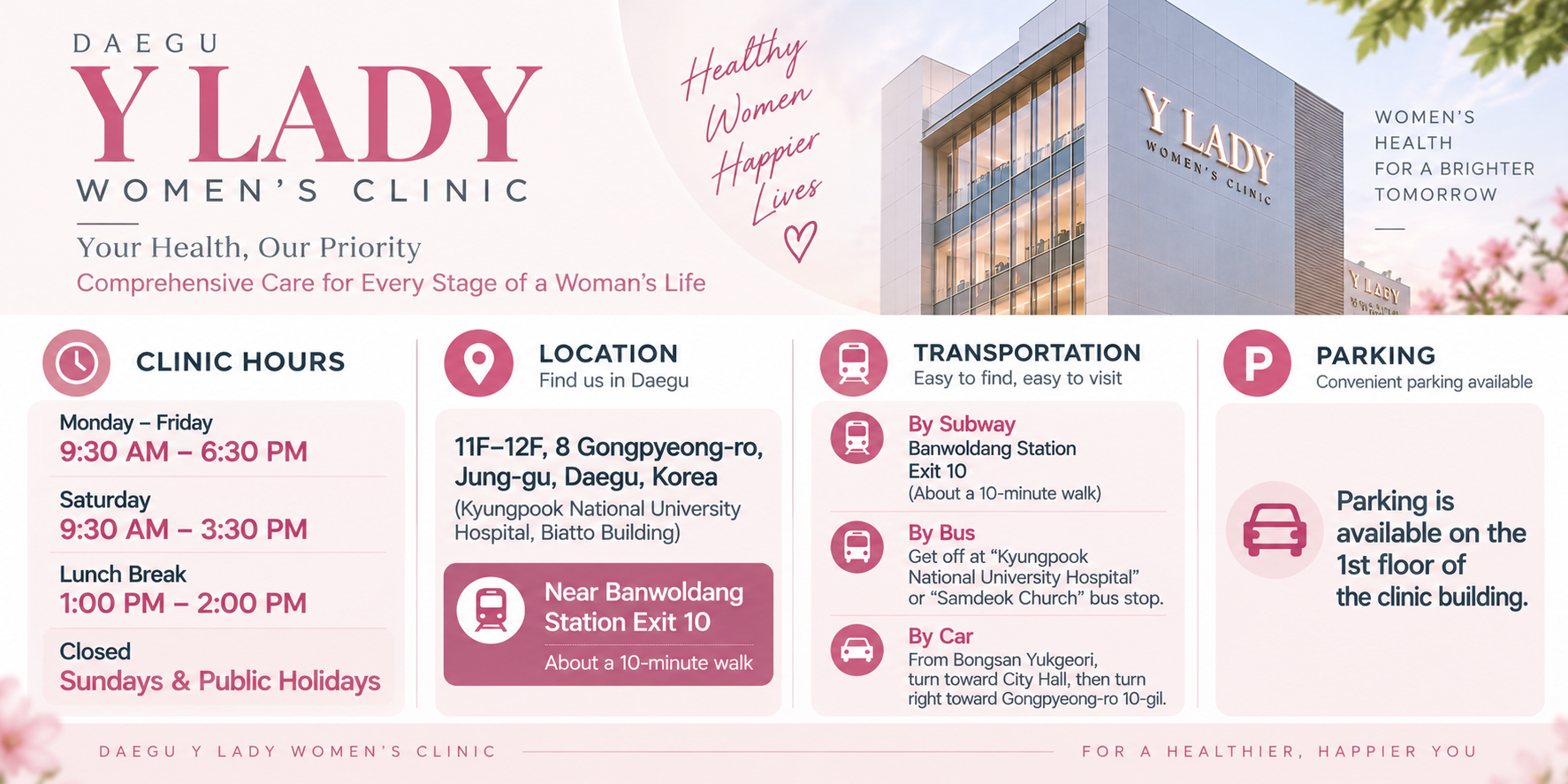
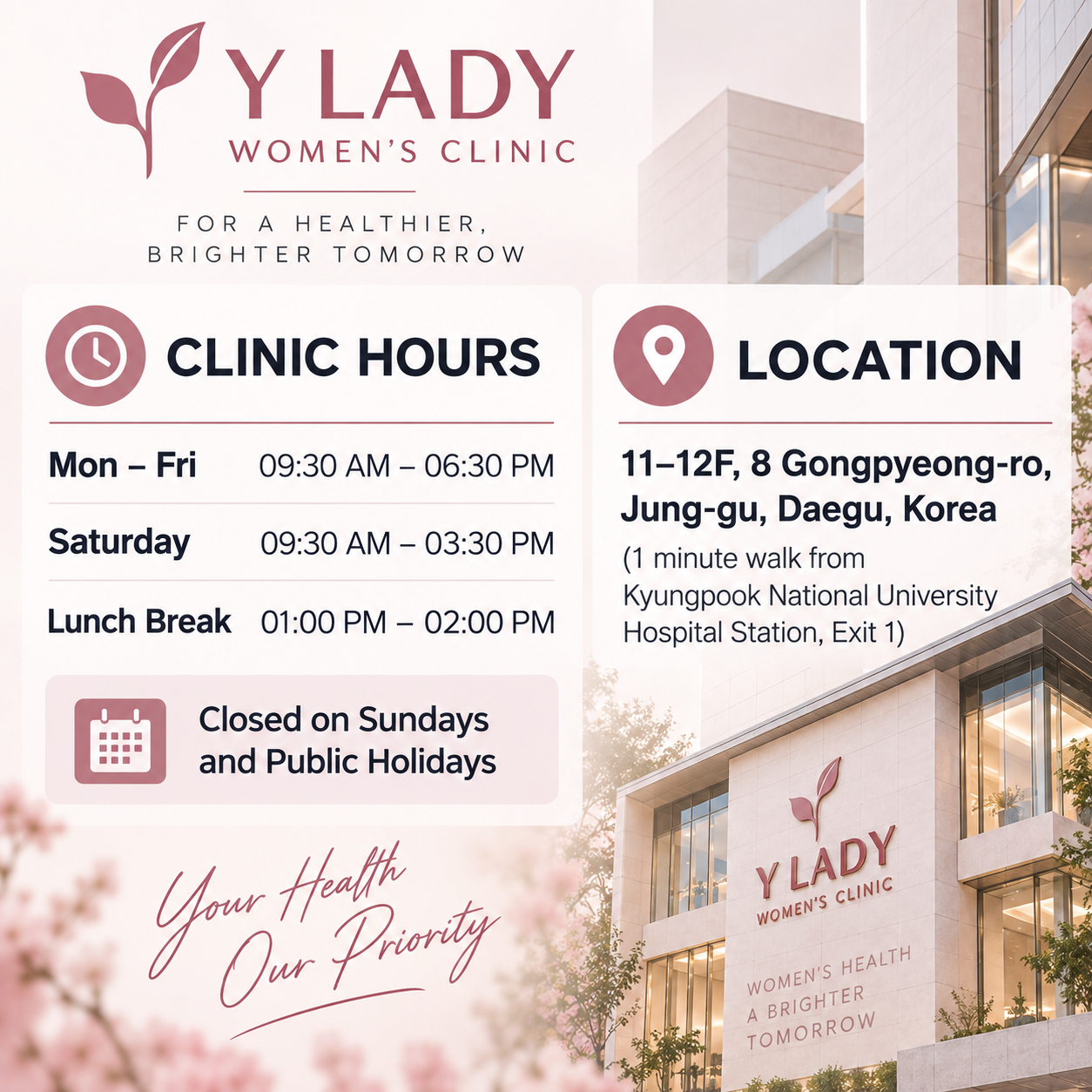
Y Lady Women's Clinic is in Jung-gu, opposite Samdeok Fire Station, near Kyungpook Nat'l Univ. Hospital Station (Line 3) and Banwoldang Station (Lines 1 and 2). For taxis, show this address: 대구광역시 중구 공평로8길 11-1 2층.
What should you do in a gynecological emergency?
Call 119 or go directly to a hospital emergency room. Clinics are not emergency facilities, and a referral letter isn't needed for true emergencies.
Seek emergency care right away for:
- Heavy bleeding that soaks through pads quickly
- Severe, sudden abdominal or pelvic pain
- Pain or bleeding in early pregnancy with dizziness or fainting
- High fever with pelvic pain
The 119 service offers English interpretation. For non-emergency questions about infectious diseases, call the Korea Disease Control and Prevention Agency (KDCA) at 1339.
FAQ
Is a clinic or a hospital better for a Pap smear in Daegu? A clinic is usually the better fit. Pap smears are routine, and NHIS covers cervical cancer screening for women aged 20 and over every two years.
Can I go straight to a university hospital without a referral? You can, but you'll usually pay more. At tertiary hospitals, NHIS rates generally require a referral letter (진료의뢰서) from a clinic.
Can I give birth at an OB-GYN clinic? Only at facilities with a delivery unit. Many clinics, including Y Lady Women's Clinic, don't deliver babies, so you'd plan delivery at a hospital or women's hospital.
How much is the copay at a university hospital? According to NHIS, the outpatient copay at tertiary general hospitals is 60% of treatment costs, compared with 30% at clinics. Non-covered services are paid in full at both.
Do university hospitals in Daegu have English-speaking staff? Several do. Keimyung University Dongsan, Yeungnam University, and Daegu Fatima have international centers, and others report English-speaking staff.
What if my clinic finds something serious? The clinic doctor will explain your results and write a referral if hospital care is needed. Bring copies of your test results to the hospital.
Can I switch back to a clinic after hospital treatment? Often, yes. Once your condition is stable, follow-up care at a local clinic may be possible. Ask your hospital doctor for guidance.
Key Takeaways
- Start at a local OB-GYN clinic for routine screening, contraception, infections, and pregnancy confirmation.
- Choose a university hospital for complex surgery, high-risk pregnancy, delivery, and cancer care.
- NHIS outpatient copays are 30% at clinics and 60% at tertiary hospitals.
- A referral letter (진료의뢰서) is usually needed for NHIS rates at tertiary hospitals.
- Several Daegu hospitals offer international centers or English-speaking staff.
- In an emergency, call 119 or go to an ER.
Talk to an English-Speaking OB-GYN in Daegu
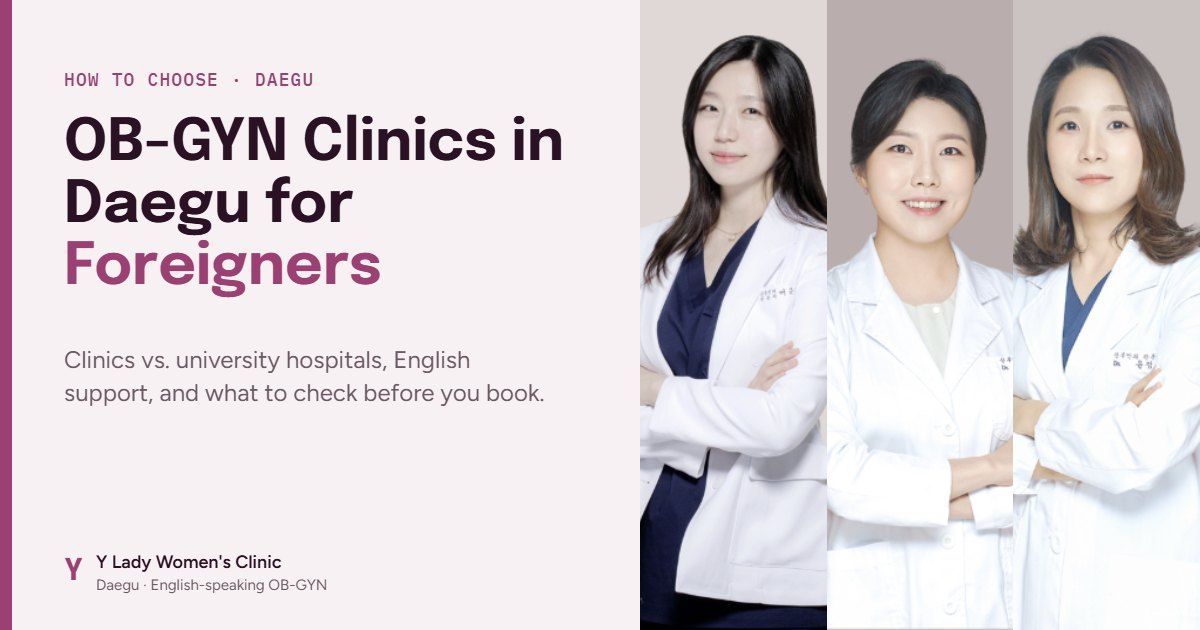
Not sure where to start? Y Lady Women's Clinic has three female, board-certified OB-GYNs who can assess your needs and refer you to a hospital if needed. Message us on WhatsApp. We reply within 24 hours, except Sundays and public holidays.
Sources